Heat-Not-Burn Product Heating Temperature Curve vs. Traditional Combustion: A Technical Comparison
In the tobacco industry's paradigm shift from "combustion" to "heating," the core technical challenge revolves around one point: how to drastically reduce harmful substance production while maintaining the aerosol yield and sensory experience users expect through precise thermodynamic control.
Last November, in a climate-controlled laboratory in Switzerland, staring at an imperfect heating temperature curve on an oscilloscope, I once again felt the brutal nature of this balance. We were debugging a prototype, trying to solve an extremely challenging problem: when the heating temperature rapidly climbed from 280°C to 320°C, the aerosol generation density exhibited highly unstable pulsating fluctuations instead of the expected steady release.
This was not merely a control algorithm problem — it was fundamentally a contest between thermodynamic curves and the phase transition process of matter.
I. Combustion vs. Heating: A Thermodynamic Disconnect
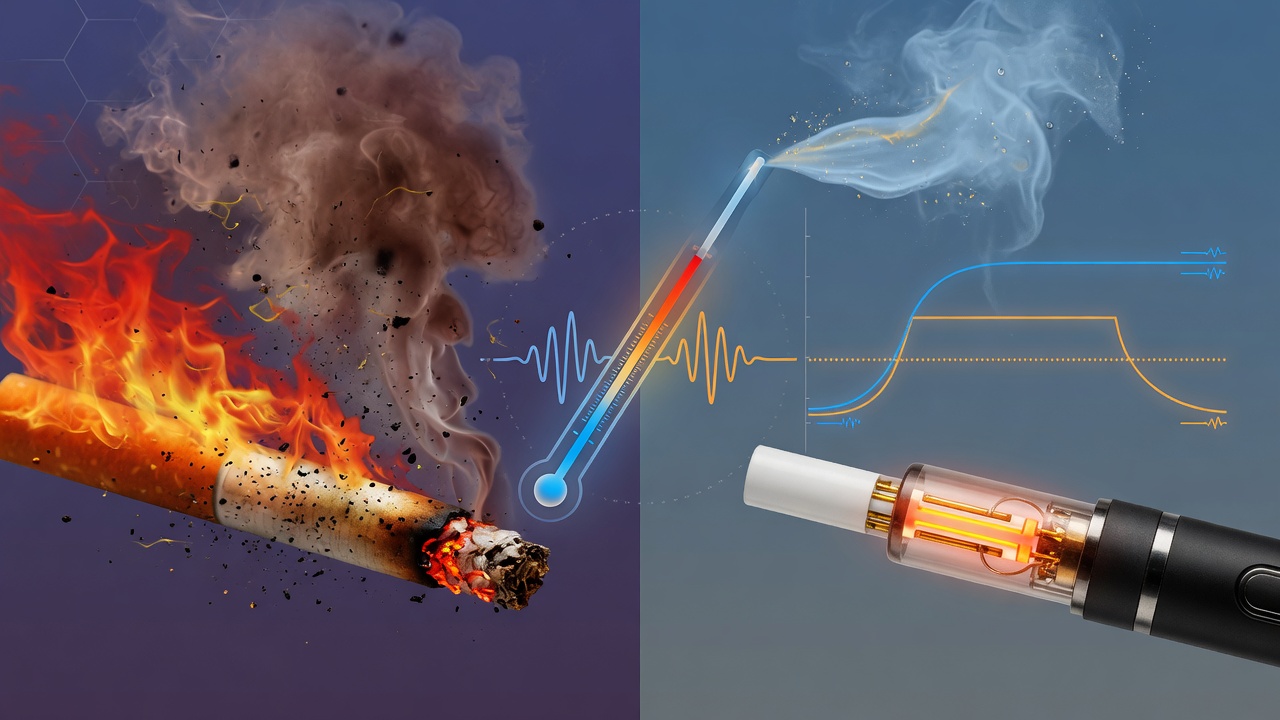
To understand the technical barriers of Heat-Not-Burn (HNB), one must first deconstruct the physical nature of traditional cigarette combustion.
Traditional combustion is a self-sustaining, intense exothermic chemical reaction. When tobacco is ignited, the energy from the flame triggers oxidation, with temperatures instantly crossing 600°C and reaching peaks of 900°C. Within this temperature range, organic matter in tobacco undergoes complete oxidation and pyrolysis. The direct consequence of such high temperatures is an extremely high yield of harmful substances (tar, carbon monoxide, polycyclic aromatic hydrocarbons, etc.) along with highly complex smoke components. During combustion, energy release is spontaneous and uncontrolled; although it can be modulated by the cigarette burn rate, its thermodynamic nature remains fundamentally "destructive."
In contrast, HNB technology attempts to achieve "pyrolysis" without ignition. We control the heat between 250°C and 350°C — a range just above the boiling points of nicotine and various flavor compounds, yet far below the threshold where tobacco fibers undergo vigorous oxidative combustion.
This represents a shift from "chemical energy-driven" to "precisely controlled external thermal energy." In this mode, the challenge is no longer maintaining a flame but designing a perfect "temperature curve" that applies energy to the tobacco substrate with extreme restraint and precision.
II. Temperature Curve: The "Baton" of Aerosol Yield
In HNB device design, the temperature profile is not a static value but a dynamic function encompassing Ramp-up Rate, Peak Temperature, Holding Time, and Cool-down Phase.
1. Heating Rate and Phase Change Control
In the early stage of the heating cycle, the heating rate directly determines the release rhythm of moisture and volatile components in the tobacco substrate.
If the heating rate is too fast (e.g., exceeding 20°C/s), heat creates localized Hot Spots on the tobacco surface. In one lab test, we observed that when the heating slope was too steep, even though the average temperature had not yet reached 300°C, local fiber temperatures momentarily surged past 400°C, causing partial Charring of some tobacco. This charring not only produces unpleasant burnt flavors but, more importantly, alters the aerosol particle size distribution, generating numerous fine particulates difficult to remove through filtration systems.
Conversely, if the heating rate is too slow, heat transfer efficiency is insufficient, preventing active components like nicotine from fully evaporating within the predetermined time, directly manifesting as users perceiving "insufficient aerosol" or "lack of throat hit."
2. Holding Phase: Key to Sustaining Aerosol Yield
During the plateau phase of the curve, temperature stability is the core determinant of aerosol yield consistency.
We need precise PID control or more advanced predictive control algorithms to maintain temperature within an extremely narrow range (typically within ±2°C). Why is this precision so critical? Because aerosol generation is exponentially related to the Vapor Pressure of substances.
For nicotine, between 250°C and 350°C, even a 10°C deviation causes drastic fluctuations in vapor pressure, leading to significant differences in aerosol density during each puff. This instability is the enemy of product sensory consistency.
3. Cool-down Phase: The Battle Against Thermal Inertia
Many engineers overlook the cool-down phase in their designs. However, because heating elements (such as ceramic heating plates) have significant thermal inertia, the temperature does not drop immediately when the heating command is stopped. If the cool-down curve is poorly designed, residual heat continues to heat the tobacco substrate after the device stops operating, causing secondary pyrolysis. This not only increases tar residue but also accelerates carbon buildup inside the device, shortening its service life.
III. Field Lessons: A Case Study on Overshoot
Returning to the Swiss lab test case I mentioned at the beginning.
We were optimizing a product using a ceramic heating core. During testing, we found that whenever the device entered the 310°C holding phase, the aerosol measurement (monitored in real-time by mass spectrometry) showed an abnormal peak, followed by a rapid drop.
Through high-frequency sampling (over 100 temperature readings per second) and thermal imaging observation, we pinpointed the root cause: Thermal Overshoot.
Due to the thermal conduction delay of the ceramic heating plate, the control system kept increasing power when it detected that the temperature had not yet reached 310°C. By the time the temperature sensor captured the target value, the energy accumulated inside the heating element had not yet dissipated, causing the temperature to momentarily surge toward 335°C before slowly falling back due to the control system's negative feedback.
- This 25°C overshoot caused disastrous physical consequences:
- **Component Imbalance**: The transient 335°C high temperature caused some heavy flavor compounds to decompose too rapidly, producing off-flavors.
- **Yield Pulse**: The instant evaporation caused by the high-temperature surge made aerosol yield spike momentarily, giving users the illusion of "suddenly large smoke volume," followed by a sensory drop as the temperature fell.
The solution was not simply reducing heating power but introducing a pre-compensation algorithm based on thermal model prediction. By constructing a precise physical model, we enabled the controller to begin reducing the Duty Cycle in advance before the temperature approached the target, thereby counteracting thermal inertia.
IV. Conclusion: Precision Control Is the Only Way Forward
The technological evolution from traditional combustion to heat-not-burn represents a leap in humanity's precision in utilizing thermal energy.
In the combustion era, we harnessed the explosive power of chemical energy; in the heating era, we leverage the refined regulation of thermodynamics. The heating temperature curve is no longer just a parameter — it is the bridge connecting physical hardware to sensory experience.
The future breakthrough will not merely lie in increasing heating power but in how to more intelligently control that curve — through more sensitive sensor feedback, more accurate thermodynamic models, and more sophisticated algorithmic compensation, achieving "milligram-level" control over aerosol yield and composition. Only then can we truly achieve the ideal state that meets both sensory needs and delivers a qualitative leap in safety.
Key Technical Parameter Comparison
Combustion vs Heating: Core Thermodynamic Differences
Traditional Combustion
- 600-900°C self-sustaining
- 15-20% harmful yield
- Uncontrolled energy release
- Complete oxidation + pyrolysis
- ±25°C fluctuation
Heat-Not-Burn (HNB)
- 250-350°C controlled
- <1% harmful yield
- Precisely regulated input
- Controlled pyrolysis
- ±2°C precision