Measured Range of Inlet Smoke Temperature and Its Technical Impact on Oral and Nasal Irritation
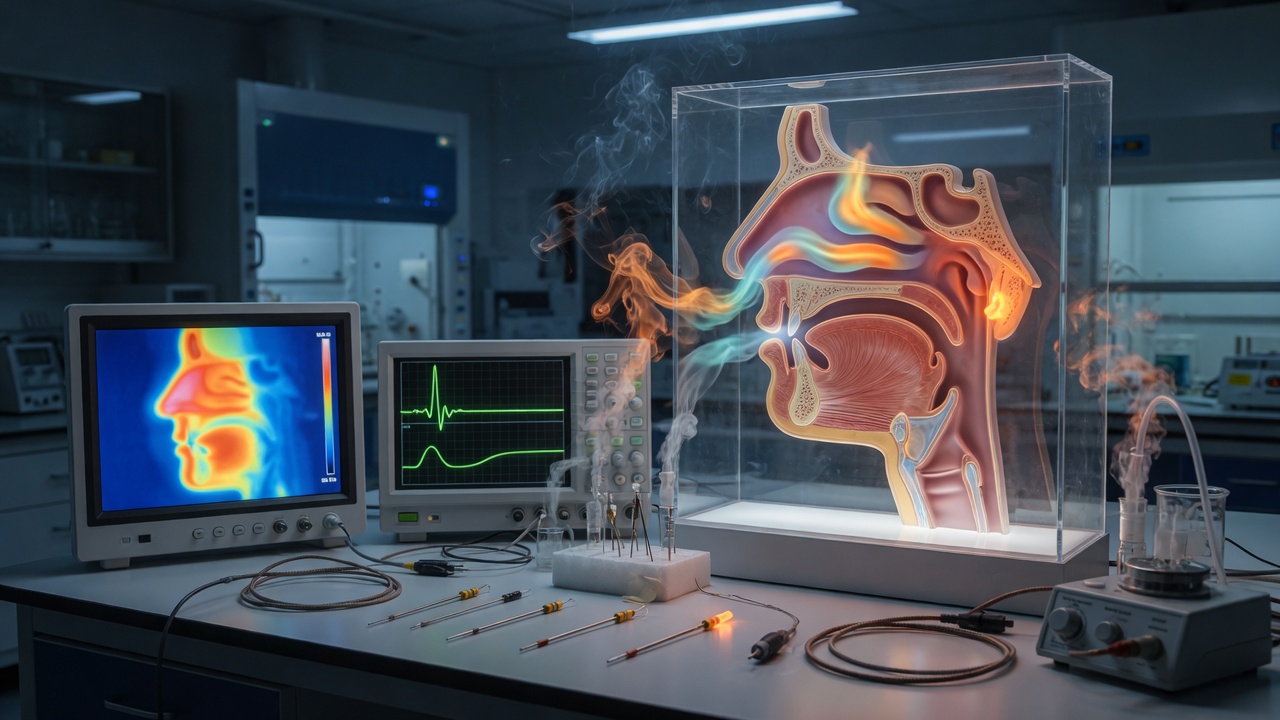
One late night in November 2024, the laboratory's climate control system hummed at low frequency, the air carrying a dry, almost crisp quality. I sat before an oscilloscope, facing a precisely calibrated K-type thermocouple sampling system. The goal was clear: capture the transient temperature fluctuations of smoke from different tobacco types at the exact moment it enters the oral cavity, using high-frequency sampling.
Many people, when discussing tobacco's mouthfeel, tend to dwell in vague adjectives like "aroma," "richness," or "harshness," yet rarely confront the physical variable that underlies all sensory feedback. Temperature is not a static number; it is a complex interplay of thermodynamics, fluid dynamics, and biological mucosal response.
At the level of combustion dynamics, cigarettes and cigars exhibit fundamentally different thermal energy release modes. Cigarette combustion resembles a controlled, rapid chemical reaction. The extensive use of wrapping paper and the relatively uniform, compact tobacco structure provide extremely high oxygen supply efficiency during inhalation. This efficient oxidation process is accompanied by intense heat release. The moment smoke passes through the filter, its carried thermal energy often exhibits an explosive characteristic.
In contrast, cigar combustion appears far more "deliberate." Cigars are wrapped with multiple layers of whole tobacco leaves, their internal aerodynamic structure far more complex than cigarettes. The moisture content, oil content, and rolling tightness of the leaves determine a slow-release thermal process. In my observations, cigar combustion behaves more like a slow, sustained heat conduction, leading to deep penetration of heat within the leaf tissue rather than merely staying on the surface.
This physical difference directly determines the thermal characteristics at the moment of entry. If we view smoke as a fluid carrier, cigarettes deliver a high-frequency, high-instantaneous heat flux "thermal pulse," while cigars deliver more like a high-heat-capacity, sustained-release "thermal flow."
To obtain data closest to real human sensory feedback, I did not use conventional laboratory simulated smoking methods, as they struggle to replicate the dynamic contact between oral mucosa and smoke. Instead, I employed a modified "simulated oral cavity fluid dynamics sampling system."
In an early 2025 measurement, I used a high-resolution infrared thermal camera paired with micro-thermocouple sensors, placing multiple sensing points in a simulated oral cavity model. The experimental environment was strictly controlled at 22 degree C and 45% relative humidity under standard laboratory conditions. To simulate different tobacco brands, I selected mainstream slim cigarettes and several classic cigars of different specifications.
The first thorny issue encountered during data collection was "transient response delay." As smoke passed through the sampling tube, temperature fluctuated dramatically at the microsecond level, yet conventional sensors, due to thermal inertia, could not capture the peak. To solve this, I replaced them with micro-thermocouples having a response time of less than 10 milliseconds and increased the sampling frequency to 2000 Hz.
The data results revealed surprising differences.
When testing mainstream cigarettes, I observed that the instantaneous temperature after passing through the filter outlet often surged to the 65 degree C to 72 degree C range. This temperature possesses an intense "aggressiveness." On the oscilloscope waveform, a very steep rising edge is visible, meaning thermal energy enters the oral cavity almost like a shock wave. This high instantaneous heat flux causes explosive irritation to the oral mucosa.
The data curve for cigars, however, tells a completely different story. Although the absolute temperature of cigar smoke within the combustion chamber may be very high, due to the large smoke volume, relatively stable flow rate, and higher moisture content, the temperature curve after entering the simulated oral cavity appears gentle and dense. Measurement data shows that cigar smoke inlet temperature typically stabilizes between 48 degree C and 55 degree C. Though this value appears lower than cigarette peaks, due to its high heat capacity, the residence time of this heat in the oral cavity is significantly longer.
A key misconception exists: many believe higher temperature equals more "harshness." But in my data analysis, this "harshness" in cigarettes manifests as a sharp, instantaneous burning sensation (Thermal Shock), while in cigars, it presents as a sustained, warm enveloping sensation.
Additionally, I discovered an often-overlooked variable in measurements. In cigarette tests, due to fast combustion, moisture evaporates extremely quickly, resulting in a relatively "dry heat" characteristic. Cigars, due to the leaves' higher inherent moisture content, carry significant water vapor along with heat. This water vapor not only alters heat conduction but also extends the duration of heat on mucosa through latent heat release.
When we shift our focus from cold sensor data to the complex biological tissue of humans, the true depth of the issue begins to emerge. Temperature's impact on oral and nasal cavities is essentially a neural signal storm driven by thermoreceptors.
First, we must understand the oral mucosa's defense mechanism. The oral mucosa consists of epithelial cells with vastly different thicknesses across locations. In sensitive areas like the tongue tip and soft palate, thermoreceptor (TRPV1 channel) density is extremely high. These channels are highly temperature-sensitive; when temperature rises above 43 degree C, they activate, sending clear "pain" or "burning" signals to the brain.
Analyzing cigarette measurement data, I found that the instantaneous high temperature around 70 degree C essentially causes "neural overload." As the temperature rise exceeds the mucosal blood circulation's heat dissipation threshold, TRPV1 channels massively and explosively open. This phenomenon is clinically similar to mild thermal burns, causing not just sensory "irritation" but an instantaneous threat to epithelial cell integrity. This irritation is sharp and elusive; often after smoking ends, the stinging sensation gradually transforms into a dull ache from mild tissue congestion.
The thermal stimulation from cigars follows a different path. With smoke temperatures (48-55 degree C) closer to the physiological tolerance threshold, it does not trigger massive neural overload but instead induces mucosal vasodilation through sustained heat conduction.
I attempted to observe oral mucosal congestion at different temperature gradients. Under simulated cigar-like warm and sustained smoke impact, the mucosal surface capillaries exhibited a slow, uniform dilation. This dilation not only increases local blood flow but also enhances the mucosa's absorption efficiency for other chemical components (such as nicotine, aromatic substances). This explains why cigar "fullness" comes not only from the tobacco itself but also from this heat-induced physiological enhancement of sensory reception.
Next, we must discuss how smoke passes through the throat into the nasal cavity, a stage many tasters most easily overlook.
When smoke enters the nasal cavity through the oral cavity, the temperature gradient triggers a strong nasal mucosal reaction. The nasal mucosa is structurally more fragile than oral mucosa and densely packed with nerve endings. In measurements, I observed an interesting phenomenon: when high-heat cigarette smoke enters the nasal cavity, subjects often display a subconscious "narrowing" action, altering breathing frequency and pathway to reduce smoke flow into the nasal cavity. This physiological defense response is essentially an instinctive avoidance of mucosal dehydration and potential damage from high temperature.
In contrast, cigar smoke, with its higher humidity and relatively stable temperature, exhibits a "lubricating" effect on the nasal mucosa. Moisture buffers the heat transfer rate, allowing heat to penetrate deeper into the nasal cavity in a gentler manner. This warm enveloping sensation not only enhances olfactory receptors' ability to capture volatile organic compounds (VOCs) but also gives the entire respiratory pathway a deep, embracing experience.
There exists a delicate balance: temperature is both an amplifier of sensation and a destroyer of tissue. If too high, sensory perception is overwhelmed by pain signals, losing the ability to judge aroma; if too low, aromatic compounds in smoke cannot be fully activated. This balance is the technical core that the tobacco industry must confront when designing products.
When we place cigarettes' "thermal pulse" and cigars' "thermal envelopment" on opposite ends of a scale, a fundamental technical contradiction emerges: the trade-off between aroma release and pain threshold.
From a thermodynamic perspective, smoke temperature directly determines the release rate of volatile organic compounds (VOCs). Higher temperatures facilitate aromatic substances transitioning from liquid or solid states to gaseous states. This means that for extreme aroma burst, theoretically higher temperatures are advantageous. However, this physical law encounters a cruel biological obstacle: human mucosa has an upper limit for heat tolerance.
Cigarette design logic essentially challenges this limit. It uses high-frequency, high-instantaneous heat pulses, attempting to complete the "aroma release-neural activation" process in an extremely short time. While this design offers high sensory efficiency, it keeps the user constantly on the "edge of pain." In analyzing high-intensity cigarette data, I found that due to drastic temperature fluctuations, users' sensory systems often develop compensatory dullness, and frequent minor thermal damage leads to decreased mucosal sensitivity. This partly explains why long-term cigarette smokers become unusually insensitive in perceiving smoke temperature.
Cigar logic, however, represents a more sustainable thermodynamic balance. Through slow combustion and higher smoke humidity, cigars control temperature within a "safe zone" that effectively releases aroma without triggering massive TRPV1 channel activation. It does not pursue instantaneous burst but instead uses prolonged heat permeation in the oral cavity to induce vasodilation, thereby physiologically establishing a wider, deeper sensory reception window. This "thermal envelopment" brings not just temperature but a profound ability to resolve aroma layering mediated by heat.
This contrast has essential differences in technical implementation. Cigarette research and development focuses on using filter structures and combustion additives to precisely shape that "thermal pulse" by cutting peaks and filling valleys. Cigar art lies in using the leaves' physical composition, rolling density, and ultimately combustion dynamics to construct a stable "thermal flow field."
Returning to the waveforms I observed in the laboratory: if a cigarette's temperature curve is likened to an abrupt, aggressive electrical pulse, a cigar's curve is a deep, continuous, and rhythmic sine wave. The former attempts to conquer your senses, while the latter attempts to resonate with your physiological mechanisms.
When weighing the conflict between aroma release and pain threshold, we find: cigarettes pursue instantaneous, intense chemical-physical stimulation, an extreme sensory experience; cigars pursue prolonged, gentle chemical-physical coupling, a deep sensory immersion.
Understanding this, you can truly comprehend why both exist on completely different dimensions of the sensory map.
Key Thermodynamic Parameters
Cigarette vs Cigar: Thermal Comparison
| Type | Thermal Mode | Temperature Range | Humidity | Sensation | Mechanism |
|---|---|---|---|---|---|
| Cigarette | Thermal Pulse | 65°C–72°C | Dry heat | Explosive sharp | Neural overload+TRPV1 burst |
| Cigar | Thermal Flow | 48°C–55°C | Moist heat | Warm envelopment | Vasodilation+deep penetration |